Friday, October 23, 2009

So Iran Caved on the Bomb. What Now? by Thomas Barnett

The deal going down in Tehran and Washington tomorrow — the one that, after days of (clearly terse) negotiations in Austria, forces Iran to ship three-quarters of its (clearly loaded) "known stockpile" of uranium to Russia for medical enrichment — is a significant feather in our Nobel-winning president's cap. No, it doesn't come anywhere close to getting Iran to give up its nuclear program — that'll never be on the table. But it does buy just enough time (one year, by all accounts) for a more reasonable diplomatic path to emerge along the bitter grounds between Iran and Israel (who aren't afraid to meet each other, by new accounts).

And that's what these kinds of negotiations have always been about: When you rightly cast aside as peacenik nonsense all this rhetorical bullshit about a "nuclear-free" Middle East (or world, as Obama likes to dream), how do you navigate Israel's unsanctioned monopoly on weapons of mass destruction? Because that's a strategically unstable situation by any historical standard.

This 365-day accord, then, would seem to be a sign that all sides involved view both Iran's enduring "breakout capacity" and Israel's missile-defense shield as constituting just enough deterrence against the region's "existential threats" — namely, Tehran's fear of U.S.-engineered regime change and Jerusalem's fear of being "wiped off the map." But how much do these two antagonists — and the Obama administration — really stand to gain over the course of the next allegedly dialed-down year? Let me count the ways.

Israel: Time to Build Up the Shield

It's stunning that Israel has gone nearly four decades unchecked with all these WMDs. But it's more stunning still that this stockpile, even as an effective deterrent against country-on-country conflict since the Yom Kippur War, hasn't really brought the Israelis any lasting peace. Meanwhile, the true Arab threat has shifted from demagogic (Ahmadinejad's big talk notwithstanding) to demographic (Israel's low birthrate relative to Palestine), and no number of nuclear warheads can balance that increasingly unfavorable correlation of forces. It was only a matter of time before the region's pre-eminent rivalry (Persian Shia versus Saudi Sunni) yielded an embryonic challenge to Israel's two hundred-plus nukes.

And so, after almost a quarter-century of quiet cooperation with the Americans, Israel is now on the verge of perfecting a multi-layered missile-defense shield that protects against short-range rockets coming out of southern Lebanon and Gaza, plus anything Iran can toss its way. Not only will Israel remain on the map following a potential first strike, it'll have second-strike capabilities secure enough to wipe off the map any fantasy-league roster of neighboring Islamic regimes you care to name.

Iran may be just getting on the playing field, but Israel will remain — for the foreseeable future — the only team that can professionally compete on both sides of the ball.

Israel's impressive achievement already creates a quiet confidence among its military ranks. Don't believe me? Check out Juniper Cobra, the two-week combined U.S.-Israeli missile-defense exercise that began this week. It's the latest in a series of biennial war games that stretch all the way back to 2001, and it lays the groundwork for next year's debut of Israel's Iron Dome system, designed to shut down those over-the-transom threats from Hamas and Hezbollah. No, this comprehensive defense package does not rule out the suitcase-bomb scenario, but that one has been around for many years and nobody has more operational experience there than Israel's intelligence agency Mossad.

The key thing to remember, once you get past Prime Minister Benjamin Netanyahu's fantastical comparisons to Nazi Germany, is that Iran's nuclear program cannot rise to the level of an existential threat — something Defense Minister Ehud Barak has already said enough times to make Tehran's Revolutionary Guard squirm.

Iran: Time to Round Up the Bullies

Speaking of which, not enough attention was paid to two bombings on Sunday morning that served as a warning to Tehran's very power-hungry Revolutionary Guard. The message? Your bullying may have worked in the wake of the Iran election, but it's go-for-broke time for the opposition.

Iran may be 90 percent Shia, but barely a majority of its citizens speak Farsi, meaning today's version of the Persian Empire isn't all it's cracked up to be — or becoming. Tehran may reflexively accuse its preferred villains (U.S., U.K.) of "meddling" in its internal affairs, but its near-term fears involve Pakistan's military push into South Waziristan, which brings Islamabad's fight with the Pakistani Taliban right to the doorstep of the restive Baluchistan region it shares with Iran and Afghanistan (which is where those bombs went off). Under the right conditions, what has long been a low-grade insurgency inside Iran could blossom into something far more destabilizing.

So with everything Ahmadinejad has on his domestic plate, it's clear that his administration could use a lengthy breather from all this Western pressure on its nuclear program — if only for the Revolutionary Guards to fully consolidate their power grab. The key for the regime has always been to thread the needle between its citizenry's pride in defying the West over enrichment and growing popular demands for more openness to the world. If this week's deal can substitute for the West's standing "freeze-for-freeze" offer (Iran freezes enrichment and the West freezes sanctions), then Ahmadinejad and Co. can claim a victory of sorts — more openness and the right to enrichment preserved.

The key to the new enrichment accord will be Tehran's willingness to hand over the bulk of its low-grade uranium all at once rather than piecemeal. The bulk shipment would indicate that Iran is at least a year off from replenishing its supplies from still-unknown enrichment facilities, like that of the "new" site that's suddenly up for inspections. So we'll see.

Obama: Time to Make a Deal

As far as the White House is concerned, the Vienna deal obviates what would have been a humiliating diplomatic failure to enlist the support of either Russia or China for truly harsh economic sanctions — something Ahmadinejad's regime just can't afford right now. Yes, some in the Obama administration surely dream that another year's time might just be enough to convince Beijing that other Gulf oil providers can cover China's energy imports from Iran in the event of any seriously going-to-the-mattresses scenario, but, as I've said in this space before, such diplomacy is a fool's errand. Beijing isn't worried about Iran lashing out against Israel but Saudi Arabia, its single biggest source of imported oil. So no matter how America seeks to shuffle the deck chairs, China's Titanic-sized fears will never be extinguished.

In the end, for all of Obama's grand rhetoric on ridding the world of nuclear weapons, history has doomed him to preside over the emergence of two rogue nuclear regimes (North Korea and Iran). China is clearly in charge of managing the true nutcase that is Kim Jong-Il, but Obama has a real opportunity with Iran. With his Nobel providing diplomatic top cover, the president should eventually be able to demand and obtain a regional security dialogue that calms down Tehran over regime change while drawing it into talks with both nuclear Israel and the inevitably nuclear Saudi Arabia.

Yes, it's a scary path. But the world has to walk down it, and this week was a big step.

Nation’s First Open Source Election Software Released by Kim Zetter

A group working to produce an open and transparent voting system to replace current proprietary systems has published its first batches of code for public review.

The Open Source Digital Voting Foundation (OSDV) announced the availability of source code for its prototype election system Wednesday night at a panel discussion that included Mitch Kapor, creator of Lotus 1-2-3 and co-founder of the Electronic Frontier Foundation; California Secretary of State Debra Bowen; Los Angeles County Registrar-Recorder Dean Logan; and Heather Smith, director of Rock the Vote.

The OSDV, co-founded by Gregory Miller and John Sebes, launched its Trust the Vote Project in 2006 and has an eight-year roadmap to produce a comprehensive, publicly owned, open source electronic election system. The system would be available for licensing to manufacturers or election districts, and would include a voter registration component; firmware for casting ballots on voting devices (either touch-screen systems with a paper trail, optical-scan machines or ballot-marking devices); and an election management system for creating ballots, administering elections and counting votes.

“How we vote has become just as important as who we vote for,” Miller told the audience of filmmakers and technologists who gathered at the Bel-Air home of film producer Lawrence Bender to hear about the project. “We think it is imperative that the infrastructure on which we cast and count our ballots is an infrastructure that is publicly owned.”

Miller said the foundation wasn’t looking to put voting system companies out of business but to assume the heavy burden and costs of research and development to create a trustworthy system that will meet the needs of election officials for reliability and the needs of the voting public for accessibility, transparency, security and integrity.

“We believe we’re catalyzing a re-birth of the industry … by making the blueprint available to anyone who wants to use it,” Miller said.

The foundation has elicited help from academics and election officials from eight states as well as voter advocacy groups, such as Rock the Vote and the League of Women Voters, to guide developers in building the system. Technology bigwigs such as Oracle, Sun and IBM have also approached the group to help with the project.

“That was unexpected,” Miller said.

The code currently available for download and review represents only a small part of the total code and includes parts of an online voter registration portal and tracking system, election management software and a vote tabulator. Prototype code for producing ballots has been completed and will be posted soon. Code for auditing is still being designed.

The voting firmware and tabulator program are built on a minimized Linux platform (a stripped down version of Sharp) and the election management components are built with Ruby on Rails.

The foundation already has California, New Hampshire, North Dakota, Ohio, Oregon, Vermont and Washington interested in adopting the system and is in talks with 11 other states. Florida, which has been racked by voting machine problems since the 2000 presidential debacle, has also expressed interest, as has Georgia, which uses machines made by Premier Election Solutions (formerly Diebold Election Systems) statewide.

“Currently two vendors impact 80 percent of the vote” nationwide, Miller said, referring to Premier/Diebold and Election Systems & Software, which recently merged in a sale. But if all the states that have expressed interest in adopting the open source system follow through with implementing it, about 62 percent of the nation’s electorate would be voting on transparent, fully auditable machines he said.

The foundation is especially interested in getting a system that would be workable in Los Angeles County, the nation’s largest and most complex election district with 4.3 million voters casting ballots in seven languages.

“If Los Angeles County figures this out, we will have solved the problems for the rest of the country,” Miller said.

Kapor called the project “a breath of fresh air” and said it symbolized the kind of “disruptive innovation” that has characterized all of the best technological developments over the last thirty years.

Slick NASA iPhone App Puts Space in Your Pocket by Betsy Mason

Can there ever be too many space photos? Here at Wired Science, we believe the answer is no, there can never be too many, or even enough, space photos. And now NASA is aiding our addiction by putting its huge collection of mind-blowing space photos in our pockets.

The new NASA iPhone app means that even when you are away from your computer (or telescope), you can gawk at nebulas and sunspots. NASA’s image-of-the-day and astronomy-photo-of-the-day collections are right there in searchable thumbnail grids. (We like the “nebula” and “mass ejection” searches.) Plus, you can e-mail or save them to your phone. It’s hard to think of a better way to get nerdy/sublime backgrounds than this app.

You can also watch videos from NASA TV of science updates, mission activity, rocket launches and other events. Another fun option is checking in on NASA’s various missions with status updates and live countdowns clocks. And if you need to know exactly where the International Space Station or space shuttle is right now, NASA has you covered with their orbit tracks overlain on Google Earth or a map with political boundaries, or both.

The New Untouchables by Thomas L. Friedman

Last summer I attended a talk by Michelle Rhee, the dynamic chancellor of public schools in Washington. Just before the session began, a man came up, introduced himself as Todd Martin and whispered to me that what Rhee was about to speak about — our struggling public schools — was actually a critical, but unspoken, reason for the Great Recession.

In our subprime era, we thought we could have the American dream — a house and yard — with nothing down. This version of the American dream was delivered not by improving education, productivity and savings, but by Wall Street alchemy and borrowed money from Asia.

A year ago, it all exploded. Now that we are picking up the pieces, we need to understand that it is not only our financial system that needs a reboot and an upgrade, but also our public school system. Otherwise, the jobless recovery won’t be just a passing phase, but our future.

“Our education failure is the largest contributing factor to the decline of the American worker’s global competitiveness, particularly at the middle and bottom ranges,” argued Martin, a former global executive with PepsiCo and Kraft Europe and now an international investor. “This loss of competitiveness has weakened the American worker’s production of wealth, precisely when technology brought global competition much closer to home. So over a decade, American workers have maintained their standard of living by borrowing and overconsuming vis-à-vis their real income. When the Great Recession wiped out all the credit and asset bubbles that made that overconsumption possible, it left too many American workers not only deeper in debt than ever, but out of a job and lacking the skills to compete globally.”

This problem will be reversed only when the decline in worker competitiveness reverses — when we create enough new jobs and educated workers that are worth, say, $40-an-hour compared with the global alternatives. If we don’t, there’s no telling how “jobless” this recovery will be.

A Washington lawyer friend recently told me about layoffs at his firm. I asked him who was getting axed. He said it was interesting: lawyers who were used to just showing up and having work handed to them were the first to go because with the bursting of the credit bubble, that flow of work just isn’t there. But those who have the ability to imagine new services, new opportunities and new ways to recruit work were being retained. They are the new untouchables.

That is the key to understanding our full education challenge today. Those who are waiting for this recession to end so someone can again hand them work could have a long wait. Those with the imagination to make themselves untouchables — to invent smarter ways to do old jobs, energy-saving ways to provide new services, new ways to attract old customers or new ways to combine existing technologies — will thrive. Therefore, we not only need a higher percentage of our kids graduating from high school and college — more education — but we need more of them with the right education.

As the Harvard University labor expert Lawrence Katz explains it: “If you think about the labor market today, the top half of the college market, those with the high-end analytical and problem-solving skills who can compete on the world market or game the financial system or deal with new government regulations, have done great. But the bottom half of the top, those engineers and programmers working on more routine tasks and not actively engaged in developing new ideas or recombining existing technologies or thinking about what new customers want, have done poorly. They’ve been much more exposed to global competitors that make them easily substitutable.”

Those at the high end of the bottom half — high school grads in construction or manufacturing — have been clobbered by global competition and immigration, added Katz. “But those who have some interpersonal skills — the salesperson who can deal with customers face to face or the home contractor who can help you redesign your kitchen without going to an architect — have done well.”

Just being an average accountant, lawyer, contractor or assembly-line worker is not the ticket it used to be. As Daniel Pink, the author of “A Whole New Mind,” puts it: In a world in which more and more average work can be done by a computer, robot or talented foreigner faster, cheaper “and just as well,” vanilla doesn’t cut it anymore. It’s all about what chocolate sauce, whipped cream and cherry you can put on top. So our schools have a doubly hard task now — not just improving reading, writing and arithmetic but entrepreneurship, innovation and creativity.

Bottom line: We’re not going back to the good old days without fixing our schools as well as our banks.

Thursday, October 22, 2009

Israel, US rehearse state of the art air defence umbrella by Gavin Rabinowitz

A massive air defence drill under way in Israel will join Israeli and US systems to create the world's most advanced anti-missile umbrella to protect the Jewish state, officials said on Thursday.

The Juniper Cobra 10 exercises, the fifth in a series of joint air defence drills between the allies, began this week and comes amid heightened tension between Israel and arch-foe Iran.

Some 1,000 US soldiers will take part in the two-week exercise combining Israeli and US systems to "create the world's most advanced air defence system to protect our citizens and homes from attack," the commander of Israel's Air Defence Corps, Brigadier General Doron Gavish, told reporters. Israeli and US commanders refused to describe the scenarios they are simulating, but said they would practise merging different anti-missile systems that defend simultaneously against long-, medium- and short-range missiles.

Israeli media reported that the exercise would likely include a scenario of a combined attack from Iran together with shorter range barrages from Syria and the Lebanese militant group Hezbollah. Rear Admiral John Richardson, the commander of the US forces, said systems used would include the American THAAD (Terminal High Altitude Area Defence), the ship-based Aegis Ballistic Missile Defence System, and the Patriot anti-aircraft system, as well as the Israeli Arrow (Hetz) II.

Israel and the US have cooperated in missile defence since the US sent batteries of Patriot missiles to Israel during the first Gulf War, when Saddam Hussein fired dozens of Scud missiles at Israel.

Israel's air defences have since been further tested. Hezbollah fired hundreds of rockets into Israel during the 2006 conflict in Lebanon and Palestinian militants have lobbed thousands of improvised rockets from the Gaza Strip.

The exercises were purely defensive and, planned nearly two years in advance, were not in reaction to any current world events, the generals said. But they come amid heightened tensions between Israel and Iran. Israel, the sole if undeclared nuclear-armed state in the Middle East, has never ruled out a resort to military action to stop Iran's nuclear drive which the West suspects is aimed at making nuclear weapons but Tehran insists is only for peaceful ends.

Iran for its part has recently tested missiles that put Israel within range and President Mahmoud Ahmadinejad has repeatedly said that the Holocaust was a "myth" and that Israel was doomed to be "wiped off the map."

NCS Develops Material That Could Boost Data Storage, Save Energy by J. Narayan, Sudhakar Nori, S. Ramachandran, and J.T. Prater, and NCSU

North Carolina State University engineers have created a new material that would allow a fingernail-size computer chip to store the equivalent of 20 high-definition DVDs or 250 million pages of text, far exceeding the storage capacities of today’s computer memory systems.

Led by Dr. Jagdish “Jay” Narayan, John C.C. Fan Family Distinguished Professor of Materials Science and Engineering and director of the National Science Foundation Center for Advanced Materials and Smart Structures at NC State, the engineers made their breakthrough using the process of selective doping, in which an impurity is added to a material that changes its properties. The process also shows promise for boosting vehicles’ fuel economy and reducing heat produced by semiconductors, a potentially important development for more efficient energy production.

Working at the nanometer level — a pinhead has a diameter of 1 million nanometers — the engineers added metal nickel to magnesium oxide, a ceramic. The resulting material contained clusters of nickel atoms no bigger than 10 square nanometers, a 90 percent size reduction compared to today’s techniques and an advancement that could boost computer storage capacity.

“Instead of making a chip that stores 20 gigabytes, you have one that can handle one terabyte, or 50 times more data,” Narayan says.

Information storage is not the only area where advances could be made. By introducing metallic properties into ceramics, Narayan says engineers could develop a new generation of ceramic engines able to withstand twice the temperatures of normal engines and achieve fuel economy of 80 miles per gallon. And since the thermal conductivity of the material would be improved, the technique could also have applications in harnessing alternative energy sources like solar energy.

The engineers’ discovery also advances knowledge in the emerging field of “spintronics,” which is dedicated to harnessing energy produced by the spinning of electrons. Most energy used today is harnessed through the movement of current and is limited by the amount of heat that it produces, but the energy created by the spinning of electrons produces no heat. The NC State engineers were able to manipulate the nanomaterial so the electrons’ spin within the material could be controlled, which could prove valuable to harnessing the electrons’ energy. The finding could be important for engineers working to produce more efficient semiconductors.

Working with Narayan on the study were Dr. Sudhakar Nori, a research associate at NC State, Shankar Ramachandran, a former NC State graduate student, and J.T. Prater, an adjunct professor of materials science and engineering. Their findings are published as “The Synthesis and Magnetic Properties of a Nanostructured Ni-MgO System,” which appeared in the June edition of JOM, the journal of the Minerals, Metals and Materials Society. The research was sponsored by the National Science Foundation.

An abstract of the paper follows.

Title: “The Synthesis and Magnetic Properties of a Nanostructured Ni-MGO System”
Authors: J. Narayan, Sudhakar Nori, S. Ramachandran, and J.T. Prater, NC State University
Published: June 2009 in JOM
Abstract: We have investigated the magnetic properties of the Ni-MgO system with an Ni concentration of 0.5 at.%. In as-grown crystals, Ni ions occupy substitutional Mg sites. Under these conditions the Ni-MgO system behaves as a perfect paramagnet. By using a controlled annealing treatment in a reducing atmosphere, we were able to induce clustering and form pure Ni precipitates in the nanometer size range. The size distribution of precipitates or nanodots is varied by changing annealing time and temperature. Magnetic properties of specimens ranging from perfect paramagnetic to ferromagnetic characteristics have been studied systematically to establish structure-property correlations. The spontaneous magnetization data for the samples, where Ni was precipitated randomly in MgO host, fits well to Bloch’s T3/2-law and has been explained within the framework of spin wave theory predictions.

Novatel MiFi 2200 Firmware Update Available Now for Verizon MiFi

The Verizon MiFi 2200 was the first to launch back in May. At the time of the launch, a few quirks were noted, the wierdest being the fact that the Verizon version would always be a live hotspot when plugged into a/c power.

New firmware for Verizon MiFi is now available. If you only ever connect to your MiFi via WiFi, its entirely possible you will never see a notice that the firmware upgrade is available.

Verizon has yet to put out any official release notes to explain what the new firmware changes... but there are rumors out there, and we have been able to confirm the following:

The Verizon MiFi will not automatically turn on its WiFi hotspot feature when plugged into its a/c wall charger.

The Verizon MiFi's web admin now shows an animated battery icon while it is being charged.

Web 2.0: Carly Fiorina Talks Potential Senate Run, Breast Cancer Battle, and Government Tech Policy by Dean Takahashi

It was a very different Carly Fiorina who took the stage at the Web 2.0 Summit dinner tonight to discuss her potential run for the U.S. Senate.

Just as it was typical when she was the first female chief executive of Hewlett Packard, part of the conversation with Web 2.0 co-host John Battelle covered her appearance. But in this case it was relevant in the discussion about her political reviews.

Fiorina’s hair was a mix of dark brown and gray and it looked as if it had been recently shaved. She said that her close-shorn look was a result of her eight-month battle with breast cancer.

“I have seen the best and the worst of our healthcare system,” she said, with her voice shaking slightly with the emotional moment that focused on her own health. But she told the audience at the dinner that she was healthy. She was there to talk about her possible bid as a Republican candidate to take on Democrat Barbara Boxer. Fiorina didn’t outright declare her candidacy, but she said she was exploring the idea.

Asked if she was ready to handle the scrutiny that politicians endure in the public limelight, she said she endured a lot of that as CEO of HP during the tumultuous years of the HP-Compaq merger, the tumultuous battle for control of the board, and her very public firing. She noted that she wrote her book Tough Choices in an honest way and in the name of being transparent.

“I have battled cancer all of these years and we had to deal with a tragedy in our family,” she said. “What people say about you publicly is important, but not profound. I felt that if you are comfortable in your own life and your own skin, bring it on.”

Five years ago, Fiorina said she would have laughed at the idea of running for public office. But she said she felt that politicians in Washington were out of touch and that the problem was that they didn’t spend enough time in private life, running businesses. She noted that she started her business career as a secretary and worked her way up. She worked at AT&T as the government broke up its monopoly on phone service.

Fiorina got polite applause, but some of her boldest comments met with silence. Perhaps that is because she was a Republican in San Francisco, a land of Democratic party dominance. But it also goes back to how she was a controversial figure when she was running what has become the world’s biggest technology company. As always, she was well spoken and her comments sometimes bordered on eloquence. That got her applause.

Fiorina wasn’t afraid to express some views. She feels that Congress doesn’t realize what it’s like to run a small business in the U.S. and how to foster innovation. She noted that she opposed the bailouts of General Motors and Chrysler — two big businesses — at the same time GM was shutting down 3,600 dealerships across the country that were run by small business people, resulting in a loss of 156,000 jobs that outnumbered the job losses at the car companies themselves. She also said that it was odd that biotech got no stimulus money, but the construction industry received a lot of it — a sign that the nation’s priorities weren’t right.

She said she is a Republican in the tradition of Abraham Lincoln in that she believes “people, left to themselves, make better decisions about their lives than the government does.” She also said that current politicians have done nothing to curb the $1 trillion deficit and that there is no one in charge of cutting costs in Washington.

She praised the way current HP CEO Mark Hurd has run the company. And she acknowledged that she made mistakes. One of them, she said, was not dealing with her “dysfunctional board” early on and instead focusing on the execution of the HP-Compaq merger instead. That ultimately came back to haunt her, leading to her ouster. But she noted with some satisfaction that the people responsible for her firing — such as Tom Perkins and Patricia Dunn — were fired themselves not long after she left. (Dunn was fired for initiating a controversial spying program aimed at finding out board leaks; Fiorina reminded the audience that she was a victim of that spying program as well).

She mentioned that politicians should be held accountable just the way that business managers and board members are, and that the U.S. government cannot continue to spend money without dealing with entitlement programs such as Medicare and Social Security. Fiorina criticized Boxer for successfully sponsoring only three relatively insignificant bills in her 18 years in the Senate.

“I don’t think that’s good enough,” she said.

Asked what she thought about regulation of the web, she said it was inevitable that there would be more regulation of it. Why, for instance, is there no protection of women and children on the Internet, when there is plenty in real life. She said this duality — where anything goes on the wild wild west of the Internet — would have to end.

Asked about political power, she noted that the worst expression of power is when someone says you have to do something ”because I say so.” She said that influencing people to do the right thing is underrated in that respect. As for the war in Afghanistan, she said that she didn’t agree with convervative commentators who believed the war effort should be separated from the idea of “nation building.” She agreed with the Obama administration approach, she said, of trying to win over the population through efforts to restore civilian security, accountability, infrastructure and education.

“People give their loyalty to those who give them security and opportunity,” she said.

As for technology in government, she said that it should be used to make government more comprehensible, accessible and transparent.

Carly Fiorina video from Dean Takahashi on Vimeo.

A closer look at GE’s pocket-sized Vscan ultrasound

Last night at the Web 2.0 summit, GE’s Chairman and CEO Jeff Immelt unveiled the new Vscan ultra-smart, ultra-small, ultrasound that may one day become as indispensable as the traditional physician’s stethoscope in patient exams. The thinking behind Vscan is that costs can come down with fewer specialist referrals. Doctors can make a better diagnosis faster. And more patients can access the critical scans they need. Each of those goals is embodied in GE’s new healthymagination business strategy, which is in the spotlight for two weeks during a technology showcase that GE is currently hosting in Manhattan. In the video below, Mike Barber, Vice President of healthymagination, provides a closer look at the new Vscan technology.


Pocket-sized technology like Vscan has the potential to help redefine the physical exam and improve patient care by enhancing a doctor’s ability to quickly and accurately make a diagnosis. For critical care clinicians, Vscan can offer an immediate look beyond patient vital signs with the potential to identify critical issues, like fluid around the heart, which could be a sign of congestive heart failure. And for cardiologists, Vscan provides a dependable visual evaluation of how well the heart is pumping at a glance, so they can treat patients more efficiently.


* Read “GE Plans to Sell Phone-Size Ultrasound Device in 2010” from Bloomberg
* Read “GE unveils handheld ultrasound machine” from AP

At 12:45 p.m. yesterday, GE Reports will host a live webcast of Jeff Immelt’s press conference, which is being held at GE’s healthymagination technology showcase in Midtown Manhattan.

Read our recent stories from the new healthymagination technology showcase:
* “Vscan pocket-sized, ultra-smart ultrasound unveiled
* “A breakthrough decision support solution for docs
* “Tackling access with Brivo imaging technologies
* “The business of bringing healthymagination to market
* “At the showcase: Health by design and window tweets
* “Scintillating tech: The world’s 1st high-def CT scanner
* “Healthymagination tech showcase kicks off in NYC

Check out photos from the healthymagination showcase on Flickr.

Wednesday, October 21, 2009

Pakistan Pledges to Destroy Any Terrorist Camps on Iran Border by Paul Tighe and Ladane Nasseri

Pakistan will destroy any terrorist training camps found near the border with Iran and will work with its neighbor to fight extremists, Foreign Minister Shah Mehmood Qureshi said.

The minister said an Iranian delegation will visit Islamabad soon to discuss a suicide bomb attack in Iran’s Sistan- Baluchistan province three days ago that killed 42 people. Iran blamed the Pakistan-based Jundallah, or “Army of God,” for the attack and called on Pakistan to take action against the group.

Pakistan won’t allow its territory to be used for terrorist attacks against its neighbors, the official Associated Press of Pakistan cited Qureshi as saying yesterday. The nation has come out of a “state of denial” and is supporting the government’s war on terrorism.

The government in Islamabad is trying to avoid tensions with Iran as it battles Taliban fighters in the northwestern tribal region near the frontier with Afghanistan. India last November halted five years of peace talks with Pakistan after blaming a Pakistan-based group for attacks last year in Mumbai that killed 166 people.

Terrorism is a regional problem that requires cooperation between all the neighboring countries, Qureshi said, according to APP. The authorities in Pakistan have handed wanted terrorists to Iran in the past, he added.

Pakistan shares a 909 kilometer (565 mile) border with Iran, a 2,430-kilometer border with Afghanistan and a 2,912 kilometer frontier with India.

Revolutionary Guards

Commanders of Iran’s elite Revolutionary Guards Corps were among the victims of the attack in Sistan-Baluchistan. The corps is responsible for security in the Sunni Muslim-dominated province that borders Pakistan and Afghanistan.

Iran’s population of more than 66 million is 89 percent Shiite Muslim, while 75 percent of Pakistan’s 176 million people are Sunni Muslims.

Iran’s Foreign Ministry summoned Pakistan’s envoy in Tehran on Oct. 18 to protest the terrorists’ use of Pakistani territory to organize attacks against Iran, state-run Press TV reported at the time.

Pakistan’s government should arrest the terrorists behind the attack or allow Iranian forces to pursue them, General Mohammed Pakpour, the chief of the Revolutionary Guards ground forces said yesterday.

“Abdolmalek Rigi, the head of the terrorist group, is no doubt in Pakistan and members are being trained there by certain oppressive countries like the U.S. and the U.K.,” the general said, according to the official Fars news agency.

The U.S. and the U.K. governments have condemned the attack and rejected allegations that they are involved.

In May, at least 21 people were killed and almost 200 were injured when militants bombed a mosque in Zahedan in the province. Jundallah said it carried out that attack and also took responsibility for the February 2007 bombing of a bus in Zahedan that killed 11 civilian employees of the Revolutionary Guards.

Tuesday, October 20, 2009

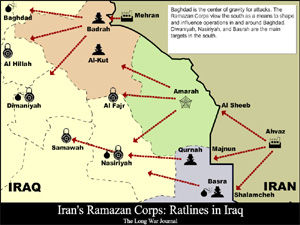
Background on Iranian Activity in Iraq (December 2007 Keynote)

Flash Presentation on the Ramazan Corps and the Iranian Ratlines into Iraq. Click the map to view. A Flash Player is required to view, click to download. Presentation by Nick Grace and Bill Roggio, December 2007.


Iraqi Forces Detain Iranian Revolutionary Guards Operative by Bill Roggioo

Iraqi security forces detained an Iranian operative in southern Iraq in the latest operation designed to curb Iran's influence in the war-torn country.

The Iraqi troops captured a weapons trafficker working for Qods Force, the covert external operations branch of Iran's Islamic Revolutionary Guards Corps, during a raid in Basrah.

"Iraqi security forces detained a wanted man in central Basrah," an official at Multinational Force Iraq told Voices of Iraq. "The man, a suspected member of the Iranian Revolutionary Guard, carries arms and munitions from a neighboring country into Iraq with the aim of backing the militias and armed groups."

Iraqi security forces have detained four Iranian operatives since the beginning of October. On Oct. 1, the US military announced that Iraqi paramilitary police from the National Emergency Response Brigade arrested Khalid Masur Isma’il during a raid in the Shia slum of Sadr City. Isma’il served as "financier and recruiter" for the Hezbollah Brigades, or Kata'ib Hezbollah, a Shia terror group that receives funding, training, logistics, guidance, and material support from the Qods Force.

Two other Hezbollah Brigades operatives have been captured in Baghdad this month. On Oct. 3, Iraqi troops arrested a man thought to be affiliated with the Hezbollah Brigades during a raid in Baghdad. Another Hezbollah Brigades operative was detained on Oct. 12, also in Baghdad.

The arrest of the Islamic Revolutionary Guards Corps officer comes just one day after the group suffered a devastating suicide attack that killed five senior Qods Force officers in Sistan-Baluchistan province in eastern Iran.

A Jundallah suicide bomber attacked a meeting between Iranian Revolutionary Guards Corps leaders and tribal leaders in Sistan-Baluchistan province, and an IRGC convoy, killing 28 officers and civilians. Brigadier General Nour Ali Shoushtari, the deputy commander for the IRGC's ground forces, and Brigadier Rajab Ali Mohammadzadeh, the IRGC's provincial commander for Sistan-Baluchistan, were killed in the attack. In a press release on its website, Jundallah claimed the commanders of Iranshahr Corps, Sarbaz Corps, and the Amir al Mo'menin Brigade was also killed in the attack.

Hezbollah Brigades targeted as pressure is eased on the League of the Righteous.

For over two years, the Hezbollah Brigades has been active in and around Baghdad. The terror group has increased its profile by conducting attacks against US and Iraqi forces, using explosively-formed penetrators and improvised rocket-assisted mortars, which have been described as flying improvised explosive devices. The Hezbollah Brigades has posted videos of these attacks on the Internet.

In July 2009, the US Treasury Department designated the Hezbollah Brigades as an insurgent and militia entity that threaten to destabilize the security of Iraq.

As the Iraqi security forces round up a senior Hezbollah Brigades leader, the US is continuing to release members of the Asaib al Haq, or the League of the Righteous, another Iranian-backed terror group.

More than 100 members of the League of the Righteous have been released since last week. According to a spokesman for the group, talks are underway with the US to release Qais Qazali, the former leader of the League of the Righteous who is currently in US custody. The US is planning to release all members of the group, even though the group is known to still hold a British hostage.

The US has also released several senior Qods Force officers, including Mahmud Farhadi, the leader of the Zafr Command, one of three units subordinate to the Qods Force's Ramazan Corps. Farhadi was among five Iranians turned over to the Iraqi government and then subsequently turned over to the Iranians in July.

Both the Iraqi government and the US military have said Iran has backed various Shia terror groups inside Iraq, including elements of the Mahdi Army. While the Iranian government has denied the charges, Iraqi and US forces have detained dozens of Iranian Qods Force officers and operatives, captured numerous Shia terrorist leaders under Iranian command, and found ample documentation as well as Iranian-made and Iranian-supplied weapons.

Since late 2006, US and Iraqi forces have captured and killed several high-level Qods Force officers inside Iraq. Among those captured were Mahmud Farhadi, one of the three Iranian regional commanders in the Ramazan Corps; Ali Mussa Daqduq, a senior Lebanese Hezbollah operative; and Qais Qazali, the leader of the Qazali Network, which is better known as the Asaib al Haq or the League of the Righteous. Azhar al Dulaimi, one of Qazali's senior tactical commanders, was killed in Iraq in early 2007.

Since mid-October 2008, Iraqi and US forces have killed one Qods Force operative and captured 17 during raids throughout southern and central Iraq.

Qods Force, the special operations branch of the Islamic Revolutionary Guards Corps, has supported various Shia militias and terror groups inside Iraq, including the Mahdi Army. Qods Force helped to build the Mahdi Army along the same lines as Lebanese Hezbollah. Iran denies the charges, but captive Shia terrorists admit to having been recruited by Iranian agents and then transported into Iran for training.

Immediately after the fall of Saddam Hussein's regime, Iran established the Ramazan Corps to direct operations inside Iraq. The US military says that Iran and Lebanese Hezbollah have helped establish, fund, train, arm, and provide operational support for Shia terror groups such as the Hezbollah Brigades and the League of the Righteous. The US military refers to these groups along with the Iranian-backed elements of the Mahdi Army as the "Special Groups." These groups train in camps inside Iran.

US military officers believe that Iran has been ramping up its operations inside Iraq since its surrogates suffered a major defeat at the hands of the Iraqi military during the spring and summer of 2008. Iraqi troops went on the offensive against the Mahdi Army and other Iranian-backed terror groups in Baghdad, Basrah, and central and southern Iraq.

More than 2,000 Mahdi Army members were killed and thousands more were wounded. The operation forced Muqtada al Sadr to agree to a cease-fire, disband the Mahdi Army, and pull the Sadrist political party out of the provincial elections. Sadr's moves caused shock waves in the Mahdi Army, as some of the militia's leaders wished to continue the fight against US forces in Baghdad and in southern and central Iraq.

Iranian-backed Shia terror groups in Iraq

The League of the Righteous is a splinter group that broke away from Muqtada al Sadr's Mahdi Army after Sadr announced he would disband the Mahdi Army and formed a small, secretive military arm to fight Coalition forces in June. The new group, called the Brigade of the Promised Day, has not been linked to any attacks since its formation last summer.

Sadr loyalist Qais Qazali was commander of the League of the Righteous up until his capture in 2007. The group is now said to be under the command of Akram al Kabi, a former Sadr loyalist.

The League of the Righteous receives funding, training, weapons, and direction from the Qods Force. The League of the Righteous conducts attacks with the deadly armor-piercing explosively formed projectiles known as EFPs, as well as with the more conventional roadside bombs.

The size of the League of the Righteous is unknown, but hundreds of members of the group were killed, captured, or fled to Iran during the Iraqi government offensive against the Mahdi Army from March to July of 2008, according to the US military.

Sadr is looking to pull the rank and file of the League back into the fold of the Sadr political movement. Earlier this year Sadr issued a message rejecting the US-Iraqi security agreement and said he "extends his hand to the mujahideen in the so-called Asaib but not their leaderships who have been distracted by politics and mortal life from the [two late] Sadrs and the interests of Iraq and Iraqis."

The Hezbollah Brigades, or Kata'ib Hezbollah, has been active in and around Baghdad for more than a year. The terror group has increased its profile by conducting attacks against US and Iraqi forces, using the deadly explosively-formed penetrator land mines and improvised rocket-assisted mortars, which have been described as flying improvised explosive devices. The Hezbollah Brigades has posted videos of these attacks on the Internet.

The terror group is an offshoot of the Iranian-trained Special Groups, the US military said last summer. Hezbollah Brigades receives funding, training, logistics, guidance, and material support from the Qods Force.

Both the US military and the Iraqi military believe that the Special Groups are preparing to reinitiate fighting as their leaders and operatives are beginning to filter back into Iraq from Iran. On Feb. 4, Lieutenant General Lloyd Austin, the deputy commander of Multinational Forces Iraq, said that Iran continues to arm, fund, and train the Special Groups, and that munitions traced back to Iran continue to be uncovered in Iraq. Recent intelligence and the finds of new Iranian caches "lead us to believe that Iranian support activity is still ongoing," Austin warned.

Monday, October 19, 2009

Mob Rule! How Users Took Over Twitter by Steven Levy

Last August, the people who putatively run Twitter — the small crew that three years ago launched the world’s fastest-growing communications medium — announced a relatively minor change in the way the site functions. The tweak would have a small effect on retweeting, the convention by which Twitter users repost someone else’s informative or amusing message to their own Twitter followers. Retweets start with RT, for “retweet,” and usually cite the first author by user ID. And, importantly, retweeters often add a word or two of commentary about the repeated content.

But there was a problem: Twitter itself didn’t invent retweeting; it was created by Twitter users. In a blog post explaining the changes to retweets, the company’s second-in-command, Biz Stone, called them “a great example of Twitter teaching us what it wants to be.” The good news, he said, was that Twitter was building retweets right into the site’s architecture. The bad news was that Project Retweet didn’t make any provision for the commentary that users might like to add.

It didn’t take long for Twitter users to respond: How dare Twitter mess with … Twitter. A self-described “social, search, and viral marketing scientist” named Dan Zarrella posted a passionate cri de coeur, writing that Twitter was about to “completely eviscerate most of the value out of retweets.” That night, Zarrella created a Twitter hashtag — another grassroots Twitter convention, which lets users group their conversations — called #saveretweets. A few tweeters liked the plan, but the general consensus was summed up by one user skilled in Twitter’s uncompromising brevity: “Very bad plan we hates it.”

The Retweet Incident is a distillation of how Twitter has come so far so fast — and how tricky it might be to keep the momentum going. In an amazingly short time, the messaging service — which does little more than circulate bursts of text limited to 140 characters to a list of people who have chosen to receive them — has established itself as a staple of social networking, commerce, electioneering, celebrity culture, public relations, media, and political protest. According to internal documents leaked earlier this year, the company expects to have 25 million active users by the end of 2009 and 100 million by the end of 2010. In 2013, it hopes to become the first Internet service to sign up 1 billion users.

There’s a big difference between 1 million adherents — roughly the number of people who receive tweets from Twitter’s CEO, Evan Williams, whose recent messages reported the birth of his first child — and 1 billion, which puts you up there with Google and soccer. Can something as elementary as Twitter become an enduring pillar of the Internet?

Perhaps, but Williams and Stone are going about it in an unusual way. They’re not laser-focused on how to fend off companies like Facebook and Google — which are madly integrating Twitter into their own business plans even as they take steps to neutralize or maybe buy it. And they don’t seem to be worried about money. The company’s revenue will be a modest $4 million or so this year. Even so, Twitter reportedly turned down a $500 million acquisition offer from Facebook last November and seems perfectly happy to burn through its roughly $150 million in investor funds.

Instead, Williams and Stone spend lots of time concocting schemes to boost the happiness quotient of a workforce that’s still only in the double figures — stuff like free lunches and inspirational visits by politicians, folksingers, and a director from the TV show House. The idea is to establish a corporate culture that will abide even when the number of employees explodes. “I feel like we’re 1 percent into this,” Stone says. “We don’t want to be that child actor who finds success early and grows up to be weird.”

But Twitter is already weird: It rocketed into the mainstream without really knowing what its service was. Its users defined it. It was those users who made Twitter into a throbbing global sensing organism that delivers instant opinion and eyewitness reporting on everything from presidential debates to football injuries. Though the company held a discussion earlier this year called “What Do We Want to Be When We Grow Up?” the mission statement is still a work in progress. “If there are three sentences I’d use to describe Twitter,” Stone says, “one of them would be ‘I don’t know.’”

As the company pursues those billion users and a business model, however, it may need to move past a studied ignorance of what it wants to be and shape its product more aggressively. The challenge is to do that without alienating the very community that’s fueling the company’s rocket-ship ascent.

Just a few years after its July 2006 launch, Twitter has ridden a wave of publicity (and serendipity) that few startups can dream of.

It’s easy to write off Twitter as a happy accident, a right-place, right-time fluke. But that misses the point. When Twitter’s creators designed the service, they made a series of crucial and deliberate decisions — ones that seem brilliant in retrospect — that created the conditions that allow users to innovate.

The first was a commitment to simplicity. A little history: Williams’ previous company was a podcasting venture called Odeo. After Apple started distributing podcasts in June 2005, Odeo was pretty much redundant, so Williams started looking for a new idea. Jack Dorsey, one of his engineers, had one for him: status updates — specifically, brief reports that answered questions like: Where are you? What are you doing?

Dorsey suggested a system that mimicked the simplicity of SMS to let users send messages from the Web or their cell phones about what they were doing from wherever they were. In March 2006, a small group including Dorsey and Stone built a prototype in two weeks. “The important thing was that we spent a lot of time getting it down to its essence,” says Noah Glass, a cofounder of Odeo who managed the so-called Twttr project. The system would receive a message from the sender and then forward it to the right people. Nothing else. Simple.

The second key decision was crucial: creating asymmetry between writers and followers. They didn’t need to be “friends” or in any way on equal footing. Anyone could read a writer’s updates, and that was powerfully liberating. “One thing I didn’t like about social networks was that awkwardness of friend requests,” Williams says. He wanted Twitter to be more like blogging, where readers pay attention to whatever they like. “That frees up creators, because they can do anything they want,” he says.

The implications were profound — and unexpected. No one thought people would want to follow strangers, or that celebrities would use Twitter to apprise fans of their activities, or that businesses would use Twitter to announce discounts or launch new products. Allowing unrestricted following eventually meant that P. Diddy could share the progress of a tantric sex session with a hundred thousand followers, and the Kennedy family could use Twitter to keep the public informed about developments in Uncle Teddy’s funeral. It obliterated the line between confidant and audience.

The third key decision was to open up Twitter to software developers from the get-go, allowing them to build their own apps and services. They could even build sites that replaced the Twitter homepage with a spiffier, more functional interface. “It just seemed like geeks would hack on it, and it would be cool,” Stone says. “We didn’t know that it was going to be a whole giant thing.”

Outsiders have enhanced the value of Twitter in countless ways, like creating software dashboards that let users navigate the Twitterverse the way a Las Vegas security honcho monitors the casino floor. Other services allow you to link tweets to pictures or video. Twitter has also led to a boom in URL-shortening services, a former backwater of Web utilities, which became vital when people wanted to include links in their tweets without the URL taking up half the space. “There may be some 50 people officially working at Twitter, but it’s more like 5,000 people work for Twitter, and they all deserve as much credit as we do,” Stone says.

The most transformative hack has been the ability to search through millions of tweets, even those posted just seconds earlier. It means anyone can monitor the hottest current topic of discussion or simply get a sense of what people are saying, in real time, about a product or movie or celebrity. A Virginia company called Summize was one of several to come up with a way to search Twitter. The technology turned out to be so important that Twitter acquired Summize and hired nearly all of its engineers.

Twitter’s evolution spawned a new grammar, and the Twitter community created many of the conventions now integral to the service. This includes hashtags (marked with a # symbol) and the @ prefix before a username. Companies using Twitter to track financial information adopted the $ sign to identify stock names. Heavy retweeting by tech guru Tim O’Reilly helped popularize the practice.

To Twitter fans, 140 characters wasn’t a limit but a jumping-off point. It might have seemed obvious that something as brief and ephemeral as a tweet was unsuitable for a press release, policy analysis, or novel, but people have used Twitter for these things anyway, sending multitweet streams that constituted a brand-new Internet genre.

Essentially, Twitter left a ball and a stick in a field and lurked on the sidelines as its users invented baseball.

If Twitter is going to make any money, however, the company has to take its own turn at bat. For most of the past two years, the focus has been simply to keep things running, reducing the nettlesome downtime that plagued the service and stemming the rising tide of spam. “We’re finally emerging from this firefighting mode,” Stone says. From here on, the company wants to put its own mark on the service, improving its homepage, producing services of its own, and refining the best ideas of its users — like retweeting.

The company has gone on a hiring spree: Recent arrivals include Douglas Bowman, a key Google designer; Alex Macgillivray, a former top lawyer at Google, who will handle possible technology acquisitions; and new COO Dick Costolo, cofounder of newsfeed company FeedBurner. Amazon.com CEO Jeff Bezos is an investor. And after closing a round of $100 million funding in September, the company will certainly hire and grow even more. As it does, it will need to balance humility and ambition. “We don’t want to get too clever and think we know everything,” Stone says. “But maybe we can serve our developers better by creating the real future they want.”

Of course, those developers won’t be too happy if Twitter winds up competing with them. And users may not embrace Twitter’s attempts at improvement. Every move the company makes comes under harsh scrutiny. Consider something as innocuous as its Suggested Users List, a collection of roughly 200 Twittering celebrities, companies, and experts that the service flags as an interesting starting point for novices. It was unveiled last February. Outrage ensued. Mahalo CEO Jason Calacanis (who has never made the list) saw it as an unearned gift to favored users and offered to buy three years of inclusion in the top 20 for half a million bucks. Tech legend Dave Winer, who describes himself as one of the site’s biggest fans, was alarmed by the company’s ability to alienate its core users in such a way. “We need to get that power out of their hands,” he wrote on his blog.

Stone and Williams hope to minimize such tensions. But they also need to assert some control over their own product. After all, there’s only so much you can do when millions of your users access your service in a way that bypasses your homepage. And, unbelievably, Twitter doesn’t even make an app for cell phones or other mobile gadgets, basically ceding that development to outsiders. “It’s nice to have the ecosystem out there innovating,” says Kevin Thau, the Twitter exec in charge of mobile. “It has created this whole communications system where people are saying, ‘What Twitter client do you use? Which one do you like?’”

It’s not that Twitter lacks ambition. The scale of its vision was revealed last summer when a hacker stole hundreds of the company’s confidential documents and leaked them to TechCrunch. The key bullet point, straight from a February 2009 strategy meeting: “If we had a billion users, that will be the pulse of the planet.”

Considering how far Twitter has come, that audacious boast is a plausible goal. (Another bullet point from the leaked memo, “Are we building a new Internet?” is a stretch.) Twitter envisions building its international audience by making deals with carriers to sell phones with Twitter connectivity built straight into the browser or texting functions. (This will help boost Twitter use in developing nations, where SMS still rules.) The company also envisions delivering content from Twitter to and from every connected device in your life, like radios and game consoles. Pulse of the planet indeed.

That’s why competing Internet giants are deeply interested in, if not outright obsessed by, Twitter. Over the past few months, Facebook has made alterations that reek of Twitter envy, like the ability to make status reports available to all Facebook users and adopting the @ sign for usernames. A stripped-down version of its service, Facebook Lite, seems to show that when Facebook is reduced to its essence, you get a real-time feed that looks like a close cousin of Twitter.

Google has made suspiciously Twitter-oriented adjustments as well. One is something called PubSubHubbub, a server protocol that could instantly push new content to users, whether it’s from a blog, Facebook, instant messaging, or Twitter. This has the potential to blunt Twitter’s uniqueness by commoditizing short bursts of information: Instead of a Twitterverse, we’d have a Statusphere distributed across dozens, even hundreds, of companies.

These plans suggest that all kinds of content could be Twitterized. It’s like email, Winer argues. It shouldn’t belong to anyone. On his blog, he suggested an open system that duplicates Twitter messages and puts them in a bucket with posts from “140-character networks formed by others, including Facebook, Yahoo, Google, who knows who.”

Williams and Stone, as you’d suspect, don’t want Twitter to become a commodity. They want to amplify Twitter so it’s as vital to your social life as Facebook and as important to your search as Google. “We want to make Twitter indispensable, so it tells people what they need to know and what they want to know and hopefully not much else,” Williams says.

If Twitter does that, he believes, the company will be wildly profitable, no matter what the skeptics say. Last summer Williams was invited to the exclusive Allen & Company confab of bigwigs in Sun Valley, Idaho. He was astonished to hear Barry Diller and John Malone, two pillars of the pre-Internet world, proclaiming that Twitter would never make much money. “I didn’t argue my case,” Williams says. “But all the Internet guys there were laughing at those media guys. Are you kidding? Do you understand how money flows to the Internet? When you know that Twitter is a vehicle for directing information and traffic to large audiences, you realize there’s obviously a huge business.”

What is that business? Twitter isn’t talking much about it, although a recent change in its terms of service opens the door to financially exploiting Twitter’s assets. Stone does say that the first stab at serious revenue will be providing services to businesses that use Twitter, helping them analyze discussions and providing them with “verified accounts” to let them communicate with customers. That doesn’t sound like much: Twitter will probably make more bucks with Google-like targeted ads, one of the other possibilities mentioned in the purloined documents. Maybe the most promising revenue streams will come from packaging and analyzing the information from the billions of tweets that are collected exclusively on Twitter’s servers. “We have a hell of a lot of data right now,” Williams says. “And we’ll have an unfathomable amount in five years.” Given those possibilities, the revenue goal outlined in the leaked memos — generating a dollar per user — doesn’t seem overly ambitious. Williams even sees a bright side to the theft of the documents. “Ironically, they may have dispelled the misperception that the company is frivolous or a flash in the pan,” he says. When he envisions Twitter five years from now, he sees an independent, profitable business with thousands of employees. “We definitely will be bigger and better, and hopefully that’s about it,” he says.

Of course, the strength of Twitter is that the company already has thousands of people defining and redefining it every day. And Williams doesn’t have to supply them with a desk or free food. Whether he can keep that workforce happy is a story that will unfold, 140 characters at a time, over the next few years.

Algae and Light Help Injured Mice Walk Again by Michael Chorost

In the summer of 2007, a team of Stanford graduate students dropped a mouse into a plastic basin. The mouse sniffed the floor curiously. It didn’t seem to care that a fiber-optic cable was threaded through its skull. Nor did it seem to mind that the right half of its motor cortex had been reprogrammed.

One of the students flipped a switch and intense blue light shone through the cable into the mouse’s brain, illuminating it with an eerie glow. Instantly, the mouse began running in counterclockwise circles as though hell-bent on winning a murine Olympics.

Then the light went off, and the mouse stopped. Sniffed. Stood up on its hind legs and looked directly at the students as if to ask, “Why the hell did I just do that?” And the students whooped and cheered like this was the most important thing they’d ever seen.

Because it was the most important thing they’d ever seen. They’d shown that a beam of light could control brain activity with great precision. The mouse didn’t lose its memory, have a seizure, or die. It ran in a circle. Specifically, a counterclockwise circle.

See the numbers.

Precision, that was the coup. Drugs and implanted electrodes can influence the brain, but they are terribly imprecise: Drugs flood the brain and affect many types of neurons indiscriminately. Electrodes activate every neuron around them.

This is bad for researchers, because practically every square millimeter of the brain contains a mess of different kinds of neurons, each specialized for a particular task. Drugs and electricity set off cascades of unwanted neural activity. Side effects.

It’s bad for patients, too. Cochlear implants, which let the deaf hear by shocking the auditory nerves, produce fuzzy sound because the electricity spreads beyond the neurons it’s aimed at. Deep brain stimulators for Parkinson’s patients allow them to walk and speak but may cause seizures and muscle weakness. Electroshock can help depression but often results in memory loss.

In 1979, Francis Crick, codiscoverer of the double-helix structure of DNA, lamented the blunderbuss nature of existing technologies. What was needed, he wrote in Scientific American, was a way to control neurons of only one cell type in one specific location. Which, nearly 30 years later, was precisely what these students had achieved.

But how could they be using light? Neurons don’t respond to light any more than muscles do. The idea sounds as crazy as trying to jump-start a car with a flashlight. The secret is that the mouse’s neurons weren’t normal. New genes had been inserted into them — genes from plants, which do respond to light, and the new genes were making the neurons behave in planty ways.

Genes are just instructions, of course. By themselves they don’t do anything, just as the instructions for your Ikea desk don’t make it leap together. But genes direct the assembly of proteins, and proteins make things happen. The weird new plant proteins in this mouse’s brain were sensitive to light, and they were making the neurons fire.

The counterclockwise-running mouse was something new — a triple fusion of animal, plant, and technology — and the students knew it was a harbinger of unprecedentedly powerful ways to alter the brain. For curing diseases, to begin with, but also for understanding how the brain interacts with the body. And ultimately for fusing human and machine.

The story of this technology starts with a most unlikely creature: pond scum. In the early 1990s, a German biologist named Peter Hegemann was working with a single-celled bug called Chlamydomonas, or, less technically, algae. Under a microscope, the cell looks like a little football with a tail. When the organism is exposed to light, its tail wags madly, moving the cell forward.

Hegemann wanted to know how this single cell, with no eye or brain, responded to light. How did it “see”? What made it “act”?

Answers slowly emerged: Hegemann and his colleagues found that part of the cell’s membrane is packed with coiled-up proteins. They theorized that when a photon hits one of those proteins, the molecule uncoils, creating a tiny pore in the membrane. Charged ions flow across the membrane, which makes the cell’s flagella move. And the whole shebang swims forward.

This was good, solid cell research. Fascinating little machines! But completely useless fascinating little machines. It wasn’t until the end of the decade that scientists figured out how they might be put to use.

In 1999, Roger Tsien, a biologist at UC San Diego, was heeding Crick’s call for better ways to trigger neurons. When he read about Hegemann’s work with Chlamydomonas, he wondered: Could that photosensitivity somehow be imported into neural cells? To do that, it would be necessary to figure out which gene made the light-sensitive protein in the Chlamydomonas cell wall. Then the gene could be inserted into neurons so that, Tsien hoped, they too would fire in response to light.

Now, using light to make neurons fire wouldn’t be a huge deal; electricity could do that. But the exciting part was that a gene could be designed to affect only specific kinds of neurons. Scientists can mark a gene with a “promoter” — a cell-specific piece of DNA that controls whether a gene is used.

Here’s what they do: Insert the gene (plus promoter) into a group of viral particles and inject them into the brain. The viruses infect a cubic millimeter or two of tissue. That is to say, they insert the new gene into every neuron in that area, indiscriminately. But because of the promoter, the gene will only turn on in one type of neuron. All the other neurons will ignore it. Imagine you wanted only the lefty in an outfield to catch. How would you do that? Distribute left-handed gloves to all the players. The righties would just stand there, fidgeting and calling their agents. The lefty would spring into action. Just as the lefty is “tagged” by his ability to use the glove, a neuron is “tagged” by its ability to use the gene. Bye-bye side effects: Researchers would be able to stimulate one kind of neuron at a time.

It was a dazzling idea. Tsien wrote to Hegemann asking for the Chlamydomonas light-sensitivity gene. Hegemann wasn’t sure which one it was, so he sent two possibilities. Tsien and his graduate students duly inserted both into cultured neurons. But when exposed to light, the neurons did nothing at all. Tsien extracted two more genes from the algae and tried one of them, but that didn’t work either. “After three strikes, you have to admit that you’re out and try something else,” Tsien says. So he moved on to another line of research and put the fourth gene back into the lab refrigerator, unexamined.

Tsien may have put his work on ice, but Hegemann and his colleagues continued searching; two years later, they inserted a gene into a frog egg and shone light on it. Voilè! The egg responded with a flow of current.

When Tsien read their paper, he recognized the gene immediately. It was, of course, the one he’d put away. “Our error was not to put it in the fridge,” Tsien says wryly, “but rather to fail to take it back out.” That’s science, though: “You win some, you lose some.” (And he did end up winning some. For his new area of research, using genes to make cells glow by cell type, he won a Nobel Prize in 2008.)

Hegemann’s team named the gene Channelrhodopsin-1. In 2003, they published a bold proposal about its variant, Channelrhodopsin-2: It “may be used to depolarize [activate] animal cells … simply by illumination.” Now someone had to find a practical use for this discovery.

Karl Deisseroth, a psychiatrist at Stanford, has seen many people with horrific brain diseases. But there are two patients, in particular, that drive his work. He once treated a bright college student ravaged by depression who had grown terrified by its assault on his mind. The other patient was frozen by Parkinson’s. The disease had slowly destroyed the motor control areas of her brain until she was unable to walk, smile, or eat. “I couldn’t save either of these patients,” Deisseroth says. “My inability to treat them, despite our best efforts, has stayed with me.”

Deisseroth, a compact man in his late thirties, is also a neuroscientist. He holds a psych clinic one day a week but spends the rest of his time running a lab. In 2003, he read Hegemann’s paper and asked himself the same thing that Tsien had back in 1999: Could the brain’s misbehaving cells be tagged genetically and controlled with light?

He took on several graduate students to research this, including Feng Zhang and Ed Boyden. Zhang had just graduated from Harvard. He is precisely spoken, his lean sentences tinged with a Boston accent overlaid on a Mandarin one. Boyden, on the other hand, talks so fast he swallows his words, as if his brain were perpetually outracing his mouth. He’s a man in a hurry. He had graduated from MIT at age 19 with a thesis on quantum computation and was pursuing his doctorate in neuroscience.

In 2005, Zhang and Boyden repeated Tsien’s experiment. This time, though, they had the right gene. They inserted it into a culture of neural tissue on a glass slide and poked a tiny electrode into one of the neurons so they would know when it fired. Then they aimed blue light at it. (Channelrhodopsin reacts most strongly to light at 480 nanometers on the spectrum, i.e., blue.)

Their apparatus looked like a microscope that spent its off-hours at the gym. It had a camera screwed into the eyepiece, a laser aimed at the slide, and big boxes of circuitry for amplifying the tiny current they hoped to see. If the cell fired, a huge in-your-face spike would appear on a screen. And that’s exactly what happened. With every flash, another spike marched across the whiteness.

They now had an On switch for neurons. But in the brain, it’s as important to inhibit neurons as it is to make them fire. As with computers, 0 is as crucial as 1; they needed an Off switch, too. When Boyden finished his PhD, he took an appointment at MIT and began hunting for it. He found there was a bacterial gene, halorhodopsin, that had properties suggesting it could do the opposite of channelrhodopsin. In 2006, Boyden inserted halorhodopsin into neurons and exposed them to yellow light. They stopped firing. Beautiful.

Over at Stanford, Deisseroth’s team was making the same discovery, and soon they were stopping worms in their tracks with yellow light. Other labs were already making flies leap into the air when exposed to blue light. And on The Tonight Show, Jay Leno had even joked about the technology with a clip in which he pretended to steer a “remote control” fly into George W. Bush’s mouth. The research was mushrooming, and dozens of labs were calling Deisseroth to ask for the genes. The new field was dubbed optogenetics: optical stimulation plus genetic engineering.

But neurons in petri dishes and in bugs were comparatively simple. Would optogenetics work in the staggeringly complex tangle of a mammalian brain? And could it be used to cure real brain illnesses?

By summer 2007, Deisseroth’s group had answered the first question with their counterclockwise mouse. They put the channelrhodopsin gene into the mouse’s right anterior motor cortex, which controls the left side of the body. When the light went on, the little guy went left.

Deisseroth immediately put his lab to work figuring out what part of the brain needed to be stimulated to cure Parkinson’s. Optogenetics was the ideal tool because it let researchers test various types of neurons to find which one would make legs move again, hands grasp again, faces smile again.

But test after test failed. “This was a discouraging time,” Deisseroth says. “The project was almost abandoned, because we had difficulty showing any therapeutic result.”

Many experts had thought the cure was to stimulate certain kinds of cells within the subthalamic nucleus, which coordinates motion. But when they tried that, it had no effect whatsoever. Then two of Deisseroth’s grad students began experimenting with a dark-horse idea. They stimulated neurons near the surface of the brain that send signals into the subthalamic nucleus — a much harder approach because it meant working at one remove. It was as if, instead of using scissors yourself, you had to guide someone else’s hands to make the cuts.

Their idea worked. The mice walked. In their paper, published in April 2009, they wrote that the “effects were not subtle; indeed, in nearly every case these severely parkinsonian animals were restored to behavior indistinguishable from normal.”

Over at MIT, Boyden was asking the obvious question: Would this work on people? But imagine saying to a patient, “We’re going to genetically alter your brain by injecting it with viruses that carry genes taken from pond scum, and then we’re going to insert light sources into your skull.” He was going to need some persuasive safety data first.

That same summer, Boyden and his assistants began working with rhesus monkeys, whose brains are relatively similar to humans’. He was looking to see whether the primates were harmed by the technique. They triggered the neurons of one particular monkey for several minutes every few weeks for nine months. In the end, the animal was just fine.

The next step was creating a device that didn’t require threading cables through the skull. One of Deisseroth’s colleagues designed a paddle about one-third the length of a popsicle stick. It has four LEDs: two blue ones to make neurons fire and two yellow ones to stop them. Attached to the paddle is a little box that provides power and instructions. The paddle is implanted on the surface of the brain, on top of the motor control area. The lights are bright enough to illuminate a fairly large volume of tissue, so the placement doesn’t have to be exact. The light-sensitizing genes are injected into the affected tissue beforehand. It’s a far easier surgery than deep brain electrical stimulation, and, if it works, a far more precise treatment. Researchers at Stanford are currently testing the device on primates. If all goes well, they will seek FDA approval for experiments in humans.

Treating Parkinson’s and other brain diseases could be just the beginning. Optogenetics has amazing potential, not just for sending information into the brain but also for extracting it. And it turns out that Tsien’s Nobel-winning work — the research he took up when he abandoned the hunt for channelrhodopsin — is the key to doing this. By injecting mice neurons with yet another gene, one that makes cells glow green when they fire, researchers are monitoring neural activity through the same fiber-optic cable that delivers the light. The cable becomes a lens. It makes it possible to “write” to an area of the brain and “read” from it at the same time: two-way traffic.

Why is two-way traffic a big deal? Existing neural technologies are strictly one-way. Motor implants let paralyzed people operate computers and physical objects but are incapable of giving feedback to the brain. They are output-only devices. Conversely, cochlear implants for the deaf are input-only. They send data to the auditory nerve but have no way of picking up the brain’s response to the ear to modulate sound.

No matter how good they get, one-way prostheses can’t close the loop. In theory, two-way optogenetic traffic could lead to human-machine fusions in which the brain truly interacts with the machine, rather than only giving or only accepting orders. It could be used, for instance, to let the brain send movement commands to a prosthetic arm; in return, the arm’s sensors would gather information and send it back. Blue and yellow LEDs would flash on and off inside genetically altered somatosensory regions of the cortex to give the user sensations of weight, temperature, and texture. The limb would feel like a real arm. Of course, this kind of cyborg technology is not exactly around the corner. But it has suddenly leapt from the realm of wild fantasy to concrete possibility.

And it all began with pond scum.